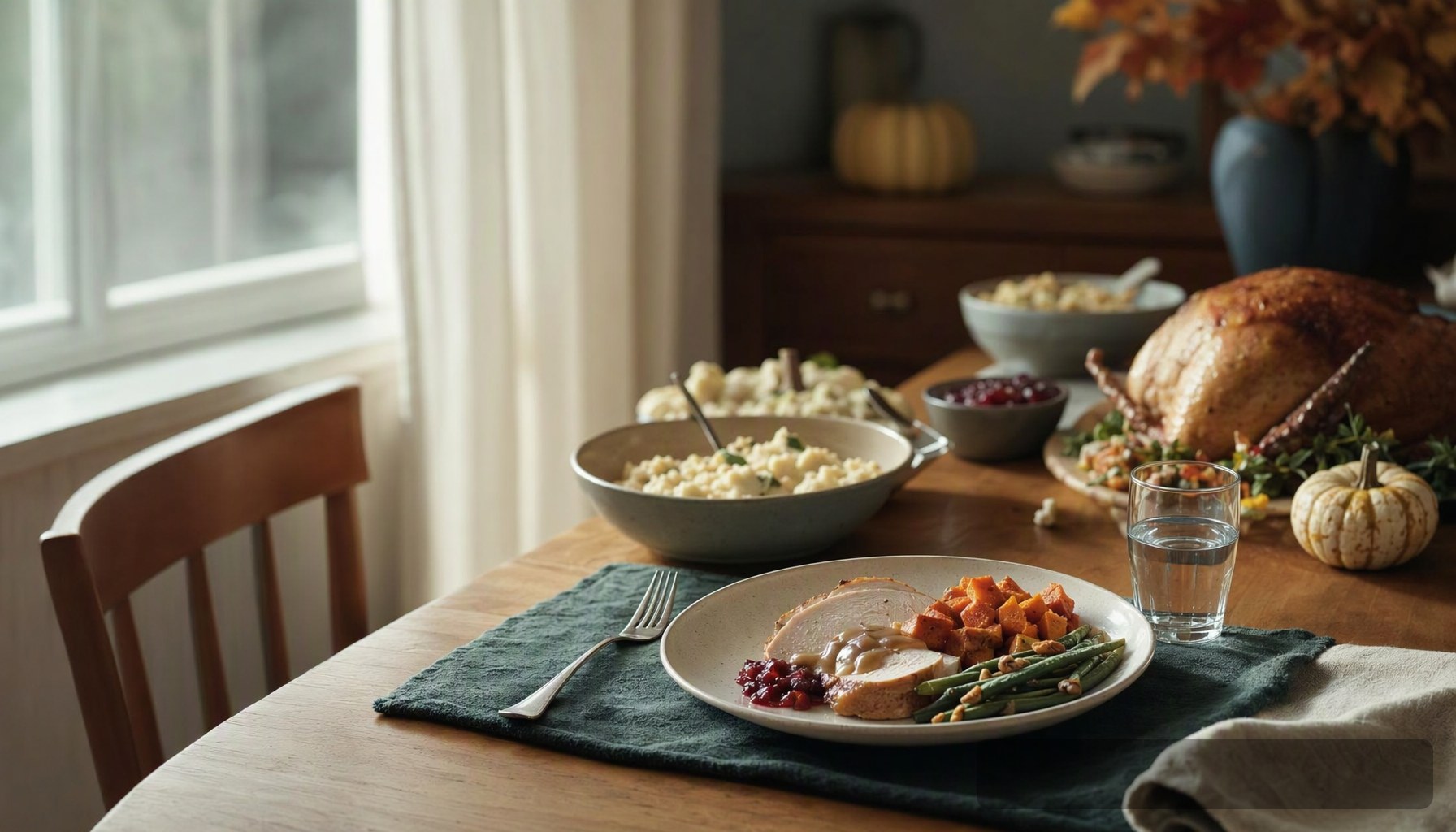
GLP-1 drugs are changing how many Canadians approach Thanksgiving, with users eating far less, adjusting meal timing, and quietly modifying recipes to manage gastrointestinal side effects.
This article is for informational purposes only and is not medical advice. Consult your Canadian healthcare provider about your situation.
Canadian pharmacies recorded $2.3 billion CAD in GLP-1 drug sales in the first half of 2026, according to IQVIA Canada data cited by the Globe and Mail, and the downstream effects are showing up at Thanksgiving tables from Chilliwack to Chatham. Semaglutide (sold in Canada as Ozempic for type 2 diabetes and Wegovy for chronic weight management) and tirzepatide (sold in Canada as Mounjaro) work partly by slowing gastric emptying and suppressing appetite. For patients on these medications, a holiday built around second helpings and rich, high-fat dishes can become genuinely uncomfortable, and sometimes medically risky.
For a Canadian patient on a GLP-1, this October's Thanksgiving is not just a social occasion. It is a practical test of how to eat safely in a setting designed for excess. A 2025 study published in Mayo Clinic Proceedings found that between 40 and 70 per cent of GLP-1 users experience gastrointestinal side effects including nausea, vomiting, diarrhea, and constipation. High-fat foods and large portions are among the most reliable triggers. That reality is reshaping menus, dinner start times, and the social dynamics of family gatherings across the country.
What this means in Canada
Health Canada has approved semaglutide under the Ozempic brand for type 2 diabetes management and under the Wegovy brand for chronic weight management in adults with obesity or overweight plus at least one weight-related condition. Tirzepatide (Mounjaro) is approved by Health Canada for type 2 diabetes. Coverage varies sharply by province. In Ontario, OHIP does not cover GLP-1s directly; coverage depends on the Ontario Drug Benefit program for eligible recipients, and Wegovy is not yet listed on the ODB formulary as of late 2026. In Quebec, RAMQ covers some GLP-1s for diabetes indications but coverage for obesity alone remains limited. British Columbia's PharmaCare and Alberta's AHCIP have similarly narrow criteria. Many Canadians are paying out of pocket, which can run $300 to $500 CAD per month depending on the drug and dose.
The Society of Obstetricians and Gynaecologists of Canada (SOGC) has not issued a position statement specifically on GLP-1 use during holidays or on managing GLP-1 side effects in social eating contexts. The Canadian Diabetes Care guidelines, updated by Diabetes Canada, do address GLP-1 receptor agonists as a drug class but focus on glycemic management rather than lifestyle adaptation. Registered dietitians in Canada, including Andrea Holwegner, CEO of Health Stand Nutrition in Calgary, are increasingly fielding questions from GLP-1 patients about exactly these situations.
Canadian telehealth platforms including Felix, Cleo, and Science & Humans (scienceandhumans.com) offer GLP-1 prescribing and monitoring services in Canada. US-based platforms such as Hone Health and Midi do not serve Canadian patients.
What changed
The Globe and Mail's October 2026 feature by food culture reporter Dakshana Bascaramurty documents what dietitians and patients are already living: GLP-1 use has grown fast enough in Canada that its effects on food culture are visible at the household level. The story profiles several Canadian women who have independently arrived at the same adaptations.
Karen Kalinowski, 61, from Eastern Ontario, is cooking Thanksgiving herself this year because she cannot trust that someone else's preparation will be safe for her. She weighs and measures everything she eats since starting Wegovy, and has replaced butter-basted turkey with a broth-and-butter version, swapped traditional stuffing for a wild-rice alternative, and plans a baked apple with sugar-free candy in place of pie. Michelle Epp, 50, from Chilliwack, B.C., who has been on tirzepatide (Mounjaro) for a year and a half, estimates she now eats about 30 per cent of what she once did. She prioritizes protein at the table and braces herself for questions about her plate. A third patient, identified only as Melody near Peterborough, Ontario, has set a hard 7 p.m. cutoff for eating to avoid late-night indigestion, and moved her Thanksgiving dinner start time to no later than 5:30 p.m.
A November 2025 survey by Sunlight.com of 1,250 US-based GLP-1 users found that 40 per cent planned to change the timing of their dose, reduce it, or skip it entirely around Thanksgiving, sometimes against medical advice. While that survey reflects American patients, Canadian GLP-1 Facebook groups and online forums show similar discussions.
What Canadian patients should know
Holwegner's advice is direct: do not fast before a big meal to "save room," and do not skip or delay a dose without talking to your prescribing physician first. For patients using GLP-1s for diabetes, skipping a dose can cause dangerous blood sugar spikes. For those using them for weight management, fasting before a feast tends to amplify side effects rather than prevent them.
Practical adjustments that align with clinical guidance include serving smaller portions of high-fat dishes (gravy, butter-heavy mashed potatoes, pastry), prioritizing protein early in the meal, and avoiding spicy foods if heartburn has been a problem. Alcohol tolerance often changes on GLP-1s, so patients should be cautious with wine and spirits.
On the social side, patients are not obligated to disclose their medication to family members. Holwegner suggests a simple, non-specific response if questioned about a small plate: "I'm starting with this amount and I'll see how I feel." That tends to close the conversation without requiring disclosure.
Provincial differences matter for access. Patients in provinces without formulary coverage who are paying out of pocket should confirm with their pharmacy that their supply is stable before the long weekend, as GLP-1 shortages have been intermittent in Canada over the past two years.
Limitations and open questions
The 40 to 70 per cent gastrointestinal side-effect figure from the 2025 Mayo Clinic Proceedings study is a range across multiple drugs and doses; individual risk varies by drug, dose, duration of use, and the specific foods eaten. There is no Canadian-specific clinical data on GLP-1 side effects during holiday eating.
Health Canada has not issued guidance on dose timing around social eating occasions. The SOGC has not addressed GLP-1 use in the context of food culture or holiday meals. Diabetes Canada's clinical practice guidelines cover GLP-1 pharmacology but not meal-planning for holidays specifically.
Longer-term questions remain open: whether the appetite and food-preference changes patients describe (reduced cravings for sweets, aversion to fatty foods) persist after discontinuation, and whether the social and psychological dimensions of changed eating at family gatherings have measurable effects on adherence. Those questions are not yet answered in the published literature.
This article is for informational purposes only and is not medical advice. Consult your Canadian healthcare provider about your situation.
Editorial note
Hormone Journal articles are written by our editorial team and reviewed against published clinical guidelines, with a focus on Canadian patient access. We do not promote specific clinics or providers.
Sources
- In the age of Ozempic, Thanksgiving looks a little different — The Globe and Mail
- Gastrointestinal adverse effects of GLP-1 receptor agonists — Mayo Clinic Proceedings, 2025
- GLP-1 sales in Canada on pace to set a new record this year — The Globe and Mail
- Health Canada — Wegovy (semaglutide) product monograph
- Diabetes Canada 2023 Clinical Practice Guidelines — Pharmacologic Glycemic Management
- 4 in 10 GLP-1 users will delay or skip a dose for Thanksgiving — Sunlight.com survey, 2025