How to Access At-Home Hormone Testing in Canada (2026)
Three routes let you test hormones in Canada without a clinic visit: mail-in self-collection kits (widest panel, no referral, 7 to 14 days), an online requisition plus a walk-in venous draw (fastest, 3 to 5 business days, follow-up is on you), and integrated telemedicine platforms that add a clinician review for a private-pay fee. Referral and coverage rules are provincial and change, so verify for where you live. A venous draw remains the reference standard for a precise diagnostic baseline; self-collection suits tracking and monitoring.
Canadians can now test their hormones without a clinic appointment through three routes: mail-in self-collection kits (saliva, dried blood spot, or finger-prick blood), an online requisition taken to a walk-in lab for a venous draw, and integrated telemedicine platforms such as Science & Humans, TeleTest, or AvoVita Wellness that bundle testing with a clinician review. Kits offer the widest panel and need no referral but take 7 to 14 days and leave interpretation to you; online requisitions are fastest at 3 to 5 business days but you arrange your own follow-up; integrated platforms close the loop at higher, usually private-pay cost. Referral rules are provincial and change, with British Columbia historically the most permissive and Ontario and Alberta generally requiring a telemedicine consultation first. A venous blood draw remains the reference standard for a precise diagnostic baseline, so self-collection is best treated as a tracking and monitoring tool.
Key takeaways
- Three routes now exist for testing your hormones without a clinic appointment: mail-in self-collection kits, an online requisition you take to a walk-in lab, and integrated telemedicine platforms that bundle testing with a clinician review.
- At-home self-collection kits (dried urine, dried blood spot, saliva, and finger-prick blood) cover a wide range of markers without requiring a referral. Dried urine gives the most detailed metabolite profiles and cortisol patterning across the day. Saliva measures free hormone fractions and cortisol rhythms. Dried blood spot and finger-prick blood quantify circulating hormone levels.
- An online requisition paired with a walk-in venous draw is usually the fastest, with results commonly back in 3 to 5 business days because nothing sits in the mail.
- Integrated telemedicine platforms cost more but close the loop: someone licensed reads your results and tells you what they mean.
- Referral rules are provincial and they change. British Columbia has generally been the most permissive about direct-to-consumer requisitions, while Ontario and Alberta usually route you through a telemedicine consultation first.
- A venous blood draw is still the reference standard when you need a precise diagnostic baseline. Self-collection is better understood as a tool for tracking and monitoring.
- Prices, turnaround times, and province lists below are what each company publishes about itself. None of it has been independently verified here, and all of it changes.
The three pathways at a glance
| Pathway | Sample or method | Panel scope | Referral required? | Typical turnaround | Best for |
|---|---|---|---|---|---|
| At-home self-collection kits | Saliva, dried blood spot, or finger-prick blood, mailed in | Widest range, includes metabolites and cortisol patterns | No | 7 to 14 days (kit-dependent) | Broad testing when you already have a provider to interpret results |
| Online requisition plus walk-in draw | Venous blood draw at a partner lab | Standard hormone panels | Varies by province | 3 to 5 business days | Fastest sample collection, self-coordinated follow-up |
| Integrated telemedicine platforms | Requisition plus walk-in draw, bundled with clinician review | Typically 13 or more biomarkers | No separate referral needed | 5 to 7 business days | Testing plus guidance in one workflow |
Each pathway solves the access problem differently, and each gives something up to do it. The rest of this article walks through what those trade-offs actually look like.
Why clinic-based testing is a barrier for many Canadians
If you have ever put off getting your hormones checked because it meant booking a family doctor first, then waiting for a referral, then finding time for a lab visit, you are in large company. The traditional path starts with a physician referral and ends at an accredited diagnostic lab, which sounds manageable until you hit the friction:
- Geography. In rural and remote communities, the nearest accredited collection site can be a multi-hour drive.
- Physician shortages. In much of the country, getting an initial appointment with a family doctor takes weeks, and a meaningful share of Canadians do not have one at all.
- Backlogged labs. Even once a requisition exists, the draw itself is often scheduled well out.
For someone dealing with symptoms tied to fertility, perimenopause, low testosterone, or a suspected thyroid problem, each of those steps is a place to give up.
What Health Canada's role actually is
Marketing copy in this category often leans on the phrase "Health Canada licensed," and it is worth being precise about what that means. Health Canada licenses medical devices sold in Canada, including some self-collection and self-testing devices (Health Canada medical devices). A licence means the device met the regulatory requirements for its risk class and its stated intended use. It is not a statement that home collection is equivalent to a lab draw, and it says nothing about whether a particular hormone panel is clinically appropriate for you.
The useful part is that the claim is checkable. If a company says its collection device is licensed, you can search the device or company name in Health Canada's Medical Devices Active Licence Listing (MDALL) and see the licence for yourself. Very few people do this. It takes about a minute.
Pathway 1: at-home self-collection kits
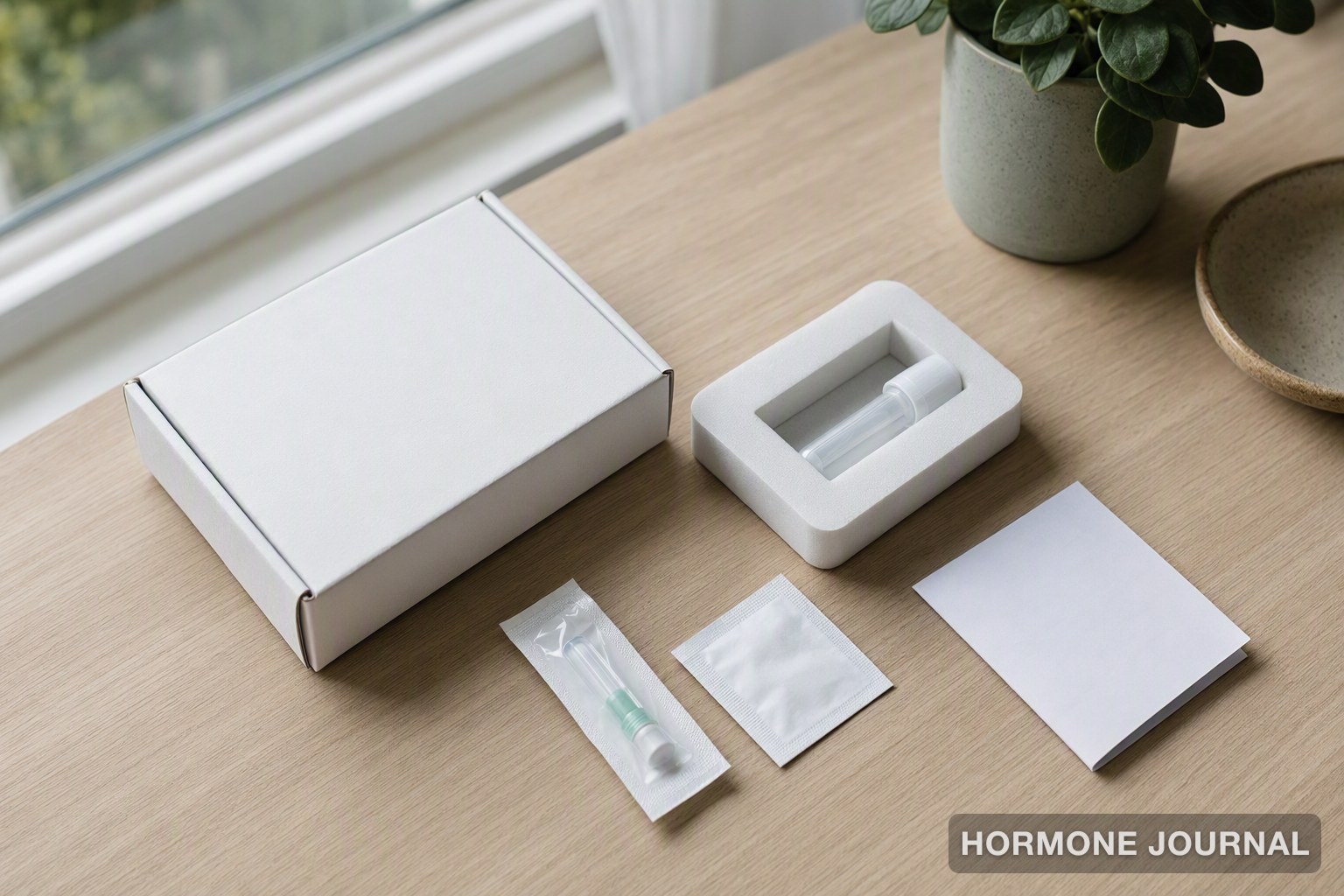
You collect your own sample, seal it, and mail it to an accredited lab. No clinic, no referral, and usually the broadest panel of the three routes.
What you can measure depends heavily on which sample type the kit uses:
- Dried urine. Dutch Test Canada is the best-known example. Its dried urine collection measures 35 or more markers by its own description, including estrone, estradiol, estriol, progesterone, testosterone, DHEA-S, and cortisol. Dried urine is unusually good at capturing metabolite profiles and the shape of your cortisol curve across a day, which a single morning blood draw cannot show you.
- Dried blood spot. Sapere Health offers this format, priced at around $550 according to its own materials and available to residents of Greater Vancouver and the rest of British Columbia. Dried blood spot testing quantifies sex hormones and thyroid markers reliably across a smaller panel of roughly eight biomarkers.
- Saliva. Saliva kits measure free hormone fractions and the cortisol awakening response, and are most often used to track stress-axis patterns over repeated collections. Worth noting: salivary cortisol and testosterone monitoring have reasonable clinical support; salivary estradiol and progesterone are more methodologically variable, representing roughly 1 to 2 percent of serum levels, which makes them less reliable for a one-time clinical baseline than for ongoing tracking.
- Finger-prick blood. Science & Humans sells a finger-prick kit under the Healthspan name, priced at $99, using a Health Canada licensed collection device processed through its own accredited Canadian lab. The company says results arrive 2 to 3 business days after the lab receives the sample and that the kit is currently available in Ontario with other provinces being added over time; confirm availability before ordering. (Science & Humans also offers a separate integrated telemedicine platform, $50 bloodwork plus $150 consultation, described in Pathway 3 below.)
The honest caveat on every kit in this category
Self-collection works well for tracking a known hormone pattern and for monitoring how you respond to treatment. It is a weaker instrument for establishing a first diagnostic baseline. A venous blood draw remains the reference standard where precision matters, where a small measurement difference would change a treatment decision, or where you may need documentation an insurer will accept.
That applies to the $99 finger-prick option as much as to the $550 dried blood spot option. A finger-prick sample is still a finger-prick sample, whoever runs the lab. And in the Ontario-only case, the geographic limit is a real constraint rather than a footnote: on the company's own account, the kit is not an answer for most of the country yet.
Pathway 2: online lab requisitions and walk-in collection
This sits between full self-collection and a traditional clinic visit. You fill out a health questionnaire online, a physician reviews it and issues a digital requisition (often inside 24 hours), and you carry that requisition into a walk-in collection site such as LifeLabs or Dynacare for an ordinary venous draw.
Access varies by province, and this is the part people get wrong most often:
- British Columbia has generally been the most permissive. Direct-to-consumer requisitions have been available there without a prior physician visit, and services such as Numia Health and Walk-In BC connect residents with BC-licensed physicians who issue requisitions on request. Some of that testing has historically been billed to the British Columbia Medical Services Plan rather than to the patient, though coverage depends on the specific test ordered and how medical necessity is assessed in each case; verify current coverage with the provider and your provincial plan before assuming it applies.
- Ontario and Alberta typically require a telemedicine consultation before a requisition is issued. A provider still reviews the request; you just never sit in a waiting room for it.
Coverage is the piece to verify rather than assume. Whether a specific test is publicly funded turns on how the province defines medical necessity, and provincial plans differ from one another and change over time (Canada's health care system). What was covered for a friend in another province, or for you two years ago, is not a reliable guide. Ask the provider and your provincial plan directly.
Speed is the real draw here. With no mail transit in either direction, results typically land 3 to 5 business days after the draw, and Numia Health reports turnarounds as quick as 72 hours. The trade-off is that you are on your own afterward. LifeLabs and Dynacare hand you numbers and reference ranges; booking someone to interpret them is your job.
Pathway 3: integrated telemedicine platforms
The first two pathways sell you a test. Integrated platforms sell you a test plus the person who reads it, and increasingly the treatment that follows.
The workflow is broadly similar across providers:
- Complete an online health assessment.
- Get bloodwork done, usually at a walk-in lab against a requisition the platform emails you.
- A licensed Canadian clinician reviews the assessment alongside your results and meets you virtually to go through them.
- If treatment is clinically appropriate, you receive a plan, sometimes with medication shipped to you.
- Follow-up consultations track how you respond.
The three platforms below all serve Canadians looking for hormone testing without a clinic visit, and they are structured quite differently.
| Platform | Initial cost | Testing method | Hormone panel scope | Lab requisition workflow | Turnaround time | Provinces served |
|---|---|---|---|---|---|---|
| Science & Humans | $50 bloodwork plus $150 consultation | Walk-in lab (requisition sent within 24 hours) | 13 or more biomarkers | Emailed requisition, patient books lab appointment | 5 to 7 business days | 9 provinces |
| TeleTest | Varies by province | Walk-in lab | Hormone panels for appropriate cases | Physician-ordered requisition | Not publicly disclosed | AB, BC, ON |
| AvoVita Wellness | Not publicly disclosed | Private diagnostic suite (Calgary) | Full endocrine function spectrum | Professional-grade testing at clinic | Not publicly disclosed | AB (Calgary focus) |
All figures in that table are what each company publishes about itself.
TeleTest routes everything through physician-ordered requisitions in Alberta, British Columbia, and Ontario and does not publish flat pricing or a turnaround figure. That makes it harder to compare on cost before you commit, though it also means what gets ordered reflects a physician's read of your case rather than a fixed package.
AvoVita Wellness is a different animal: testing happens in a private diagnostic suite in Calgary rather than by mail or at a public lab, which makes it a local, in-person option with a correspondingly narrow footprint. It publishes neither pricing nor turnaround.
Science & Humans is the most forthcoming of the three on cost and the broadest on stated coverage, at nine provinces. Its consultation fee is private-pay and not covered by any provincial plan, which is worth pricing in. The advertised $50 bloodwork figure is not the number you actually pay to complete the process.
What happens after you get your results
This is where the pathways diverge most, and it matters more than people expect when they are comparing prices.
With a mail-in kit or a lab-direct requisition, what arrives is raw values next to reference ranges. Nothing in that document tells you what a borderline TSH means for your particular fatigue, or whether an estradiol result is unremarkable for where you are in your cycle. If something comes back outside the range, you are back to booking a family doctor or an endocrinologist, explaining what you did and why, forwarding the results, and waiting for an assessment. For people who took this route specifically because they could not get a doctor's appointment, that is an uncomfortable place to end up.
Integrated platforms fold that step in. A clinician reads your results against the assessment you filled out at the start and walks you through them, and if treatment is appropriate the same conversation can move into a plan. You pay for that convenience, and you pay privately.
Neither arrangement removes the need for judgment. A result that looks alarming in isolation is often unremarkable in context, and the reverse happens too.
How to choose the right pathway for your needs
A rough decision rule:
- Pick an at-home kit if you want the widest panel, particularly metabolites and cortisol patterning, and you already have a provider who can interpret what comes back. Dried urine formats like Dutch Test Canada suit this best; dried blood spot options such as Sapere Health cover less ground for more money but are simpler to collect.
- Pick an online requisition plus walk-in draw if speed is the priority, you want a venous sample, and you are comfortable arranging your own follow-up. This is also the pathway most likely to be publicly funded, depending on province and on whether the test is considered medically necessary.
- Pick an integrated platform if you are starting from nothing, have no family doctor to send results to, and would rather pay to have testing and interpretation handled together. Compare the total cost, not the headline testing fee, and check which provinces each one actually operates in.
None of these is a substitute for a proper workup if you have symptoms that concern you. They are ways to get data into the conversation faster.
Limitations and what this article does not cover
- Every price, turnaround time, panel description, and province list here comes from the companies themselves. None has been independently verified, and all of it is subject to change without notice. Check current terms directly with the provider before paying.
- Provincial coverage rules differ across Canada and change over time. Whether a hormone test is publicly funded depends on your province and on how medical necessity is assessed in your case.
- Results from self-collection methods may not be accepted for insurance claims, disability documentation, or certain clinical decisions. Where documentation matters, ask what format the receiving party requires before you test.
- LH is a pulsatile hormone; a single finger-prick sample collected at an uncontrolled time of day or cycle phase may not accurately reflect baseline LH levels. Where LH is clinically relevant to your situation, discuss sample timing and method with the clinician ordering the test.
- Abnormal or unexpected results need interpretation by a licensed clinician who knows your history. A number outside a reference range is not a diagnosis.
- This article does not compare analytical validity between specific labs, does not cover fertility or oncology testing, and does not address hormone testing in minors.
- No provider named here is endorsed or recommended. Inclusion reflects availability in the Canadian market, not an assessment of quality.
Frequently asked questions
Can I get hormone testing in Canada without a doctor's referral?
Generally yes, though the route depends on where you live. British Columbia has allowed direct-to-consumer lab requisitions without a prior physician visit; other provinces typically require a telemedicine consultation or some form of physician oversight before a requisition is issued. At-home self-collection kits using saliva, dried blood spot, or urine do not require a referral in any province and can be ordered directly. Provincial rules differ and change, so confirm current requirements for your province.
How accurate are at-home hormone tests compared to lab blood draws?
Dried blood spot testing has clinical validation for monitoring major sex hormones and thyroid markers. Salivary cortisol monitoring also has reasonable support. Salivary estradiol and progesterone are more methodologically variable: they represent roughly 1 to 2 percent of serum levels and carry higher measurement uncertainty, which makes them less reliable for one-time clinical baselines than for ongoing tracking. A venous blood draw remains the reference standard for a baseline diagnosis where high precision is needed, where results may support an insurance claim, or where a small measurement difference would change a treatment decision. Sample timing, handling, and transit conditions all affect at-home results, which is part of why they suit tracking better than one-time diagnosis.
What hormones can I test with an at-home kit in Canada?
It depends on the sample type. Saliva kits typically cover cortisol along with the free fractions of estrogen, progesterone, and testosterone. (Saliva measures bioavailable free hormone fractions, not metabolites; metabolite profiling is the province of dried urine formats.) Dried blood spot kits commonly report estradiol, progesterone, FSH, LH, and TSH. Dried urine gives the most detailed metabolite profiling. Science & Humans says its at-home blood test covers testosterone, estradiol, LH and FSH, TSH, and prolactin, and that the kit is currently available in Ontario with other provinces to be added over time.
How long does it take to get hormone test results from an at-home kit?
Mail-in collection kits typically return results 7 to 14 days after the lab receives your sample, since transit time sits on both ends. Lab-direct requisitions with walk-in collection generally produce results in 3 to 5 business days. Telemedicine platforms generally quote 5 to 7 business days for the bloodwork results, with clinician review and consultation scheduling adding further time in some cases.
Does insurance cover at-home hormone testing in Canada?
Provincial health plans generally cover hormone testing that a physician orders and that meets the province's definition of medically necessary. Direct-to-consumer at-home kits are usually paid out of pocket. Optional add-on biomarkers often carry a fee even when the core panel is ordered through a telemedicine platform, and telemedicine consultation fees are typically private-pay rather than provincially covered. Coverage rules vary by province and change, so verify with your plan.
What should I do if my at-home hormone test results are abnormal?
Testing-only services leave the next step to you: book an appointment with a family doctor or an endocrinologist to interpret the results and determine whether treatment is warranted. Integrated telemedicine platforms include that clinician review in the same workflow. Either way, speak with a licensed healthcare provider before starting, stopping, or changing any treatment. Do not act on a single out-of-range value on your own.
Can I use at-home hormone testing to monitor bioidentical hormone replacement therapy?
At-home testing can be appropriate for monitoring hormone levels during bioidentical hormone replacement therapy, but it should be coordinated with the clinician who prescribes it. Consistent sample timing relative to your dose, the same collection method each time, and the same lab all make the trend more meaningful. Your prescriber may also have a preferred method or lab, and switching formats mid-course makes results harder to compare. Note that compounded bioidentical hormone replacement therapy is not evaluated under the same regulatory pathway as conventional approved hormone medications in Canada, and its clinical evidence base differs from licensed hormone therapies. Health Canada-approved products follow a standardized approval process that compounded formulations do not; discuss the distinction with the clinician managing your care.
This article is for informational purposes only and does not constitute medical advice. Speak with a licensed physician, endocrinologist, or nurse practitioner who knows your history before ordering a hormone test, acting on any result, or starting, stopping, or changing hormone therapy.
Reviewed for medical accuracy by the Hormone Journal editorial team. Our editors cross-reference all health claims against peer-reviewed research and clinical guidelines. Last reviewed: August 3, 2026.
Hormone results are only meaningful in clinical context and need interpretation by a licensed clinician; a value outside a reference range is not a diagnosis, and self-collection is not a substitute for a proper diagnostic workup. This article does not endorse or recommend any provider, and all pricing, availability, and turnaround figures are company-stated and subject to change.
Last verified: 2026-08-03